
Building a Dock on Lake George, Florida: What the Wind and Waves Mean for Your Build
Lake George isn't like the other lakes we build on. It's not a quiet spring-fed pond surrounded by cypress trees. It's the second largest lake in the state of Florida — 46,000 acres, 11 miles long, 5 miles wide, and fed by the St. Johns River from the south. When the wind picks up and blows down that 11-mile fetch, the water doesn't ripple. It builds real waves — the kind that snap pilings, rip decking loose, and turn a dock that wasn't built for this lake into a repair job within its first year.
We build docks on Lake George, and we build them differently than we build on the Harris Chain or Lake Weir or the smaller lakes in Marion County. The engineering is different. The materials are different. The piling depth is different. Everything about this lake demands more from a dock, and if your builder doesn't understand that going in, you're going to find out the hard way — usually during the first summer storm that blows north up the St. Johns corridor.
Here's what goes into building a dock on Lake George that actually lasts.
Why Lake George Is a Different Build Than Most Central Florida Lakes
The problem isn't depth — Lake George averages about 8 to 10 feet with a max around 20 feet. The problem is fetch. Fetch is the distance wind travels over open water before it hits your shoreline, and it's the single biggest factor in wave size and force.
On a lake like Lake Weir, the longest fetch is about two miles. On the Harris Chain, it varies by lake, but you're rarely dealing with more than a mile and a half of open water in any direction. On Lake George, the wind can travel 11 uninterrupted miles from south to north. That's enough distance to build waves that hit your dock with real force — not ocean force, but enough to fatigue connections, loosen fasteners, and destroy anything that was designed for calm water.
Add to that the fact that Lake George sits in the St. Johns River corridor, which acts as a wind tunnel during storms. The flat topography around Georgetown, Seville, and the western shore of Volusia County gives the wind nowhere to break before it reaches the water. On a 20-knot day, this lake gets genuinely rough — rough enough that experienced boaters know to check conditions before crossing.
That's the lake your dock has to live on. Every day. Through every storm. For decades.
How We Engineer Docks for High-Fetch Lakes
A dock on Lake George needs to handle three things a calm-water dock doesn't: sustained wave impact, wind uplift on the decking, and lateral racking force on the pilings. Here's how we address each one.
Deeper Pilings, Heavier Gauge
On a sheltered lake, pilings are typically driven or jetted 4 to 6 feet into the lake bottom. On Lake George, we go deeper — often 8 to 12 feet depending on the substrate — because the lateral load from wave action is constantly trying to rock the pilings back and forth. Shallow pilings in sandy bottom will work loose over a few storm seasons. Deep pilings in the right substrate don't move.
We also use heavier gauge pilings on exposed Lake George shorelines than we would on a protected canal or river lot. The extra wall thickness resists the bending moment that repeated wave cycles create, which is what eventually fatigues and cracks a standard piling at the mud line.
Cross-Bracing and Connection Hardware
Every dock we build uses structural cross-bracing, but on a high-fetch lake the bracing pattern and hardware are upgraded. We use through-bolted stainless steel connections rather than lag bolts on exposed builds, because lag bolts in wood will work loose under cyclic loading — the constant push-and-pull of wave action is the definition of cyclic loading.
The frame itself gets additional diagonal bracing to resist racking. Racking is what happens when waves hit the dock from the side and try to push the whole structure into a parallelogram shape. A dock without adequate lateral bracing will develop a lean over time, and once it starts leaning, the stress compounds with every storm until something fails.
Decking and Fastener Selection
Wind uplift is a real concern on an open lake. During a strong storm, wind can get under the decking and try to peel it off the frame — especially on covered sections and boathouses where there's a large surface area for wind to catch. We fasten decking with screws rather than nails on Lake George builds, and on boathouses we use hurricane clips and structural tie-downs the same way a roofer would on a house.
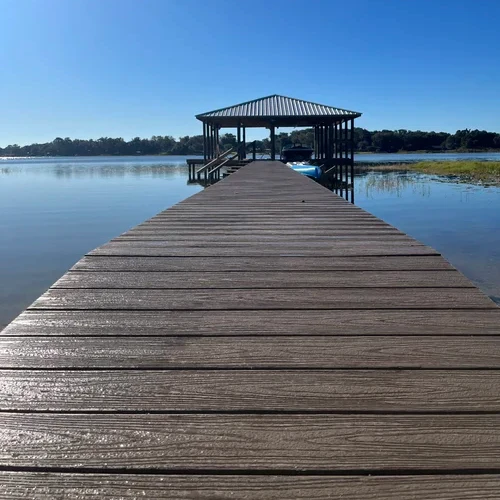
Material selection matters too. Pressure-treated pine is standard on most freshwater builds, but on Lake George we often recommend composite or hardwood decking for the outer sections that take the most wave splash and sun exposure. The premium materials handle the constant wet-dry cycle better over time, which means less board replacement and a longer interval between major maintenance.
Boathouses on Lake George — Extra Engineering, Extra Protection
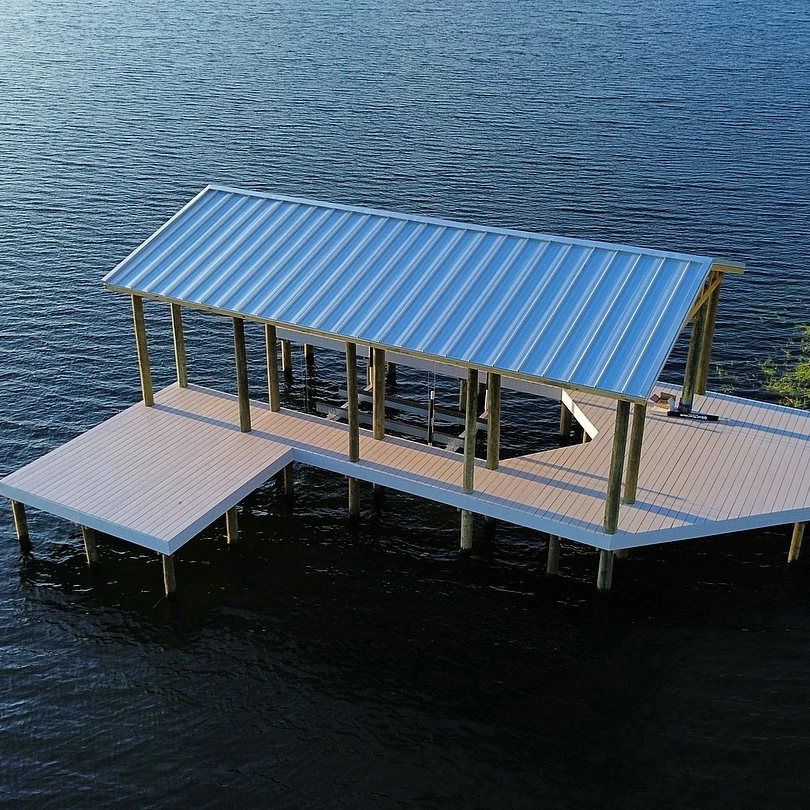
A boathouse on Lake George isn't just a convenience — it's protecting a serious investment from a lake that punishes anything left exposed. UV, wave splash, wind-driven rain, and the occasional storm surge all take a toll on a boat that's sitting uncovered at the end of a dock.
But a boathouse on a high-fetch lake also catches more wind than a boathouse on a sheltered lake. The roof becomes a sail. The walls become a target. The entire structure has to be engineered for wind loads that a boathouse on Lake Weir would never see.
We build boathouses on Lake George with the same hurricane-rated connections and tie-downs we use on our barndominiums and residential builds. Gable roofs, hip roofs, and flat roofs all have different wind profiles, and we'll recommend the right style based on your shoreline's exposure direction. A south-facing lot on the north end of the lake — where the full 11-mile fetch hits you head-on — gets a different recommendation than an east-facing lot tucked into a cove near Georgetown.
Permitting on Lake George
Lake George straddles Putnam County and Volusia County, and it's part of the St. Johns River system, which means your dock permit has to satisfy both county requirements and the St. Johns River Water Management District. Depending on the scope of your build, you may also need sign-off from the Florida Department of Environmental Protection.
Most standard residential docks fall under a general permit ($250 filing fee) as long as they meet size and setback requirements. Larger structures, boathouses, and anything that involves dredging or shoreline modification typically require an individual permit with a longer review timeline.
We handle the full permitting process on every dock we build — the applications, the drawings, the agency correspondence, and the inspections. It's the same approach we take on our seawall and marine construction projects across Central Florida. Permitting on a multi-jurisdictional lake like George can stall a project for months if you don't know what each agency wants, and we've been through the process enough times to keep things moving.
Boat Lifts for Rough Water
If you're on Lake George, you need a boat lift — full stop. Leaving a boat in the water on a lake this exposed means constant hull stress from wave action, accelerated bottom paint wear, and waterline damage that compounds over time. A lift gets your boat out of the water when you're not using it, which extends the life of everything below the rub rail.
On Lake George, we install lifts that are rated for sustained winds up to 90 mph while holding the boat. The lift cradles, cables, and support structure are all galvanized for corrosion resistance, because the constant splash and humidity on an open lake will eat unprotected steel fast.
Lift capacity depends on your boat — we install everything from 4,000-pound lifts for bay boats up to 20,000-pound-plus lifts for larger cruisers and pontoons. The key on a high-fetch lake is making sure the lift is integrated into the dock structure properly, because the weight of a lifted boat changes the load dynamics during a storm. A boat that's up on the lift in 60-mph winds adds a massive amount of windage and weight to the dock frame, and the structure has to be engineered for that combined load from day one.
What Maintenance Looks Like on a Lake George Dock
Even a well-built dock on Lake George takes more of a beating than one on a protected lake. That's not a flaw in the construction — it's the reality of building on 46,000 acres of open water. Here's what to keep an eye on:
Fasteners — Check annually for any screws or bolts that have backed out. Cyclic wave loading works fasteners loose over time, and catching one before it fails is the difference between a ten-minute fix and a board that rips off in a storm.
Pilings at the waterline — The splash zone is where damage accumulates fastest. Look for checking, soft spots, or marine growth buildup that holds moisture against the wood. Piling wraps can extend the life significantly if applied before damage starts.
Cross-bracing and connections — Walk the dock and look for any lateral movement or play in the frame. A dock that felt solid last year but has a slight wobble this year is telling you a connection has loosened or a brace has cracked.
Boathouse roofing and flashing — Wind-driven rain on Lake George comes from angles that a roof on a sheltered property never sees. Check flashing at the ridge and eaves annually.
We offer maintenance and repair work on docks we've built and docks built by others. If you're on Lake George and your dock is showing signs of age or storm damage, we can assess what it needs — whether that's targeted repairs or a full rebuild with modern engineering.
Building on Lake George? Let's Talk.
We're Central Florida dock builders with roots in marine construction going back to 1984. We've built docks, boathouses, seawalls, and boat lifts across Marion, Putnam, Volusia, Lake, and Sumter counties — and we know that a lake like George demands a different approach than a lake like Griffin or Harris.
If you're planning a new dock, replacing one that didn't hold up, or adding a boathouse or lift to an existing structure, we'll walk your shoreline, assess your exposure, and design a build that's engineered for this specific lake — not a generic plan pulled off a shelf.
Contact us to start the conversation, or call (352) 687-2030 to talk to someone today. You can also meet the team that will be out on your property.
You dream it, we build it.