Fence Installation in Central Florida: Which Material Actually Lasts and What It Costs in 2026
Not every fence that looks good on a website looks good three years into a Central Florida summer. Humidity rots wood. Sun bakes vinyl until it gets brittle if you buy cheap. Termites eat anything they can get into. And the first real storm of hurricane season will tell you exactly how deep your posts were set — whether you wanted to know or not.
We build fences across Marion, Lake, and Sumter counties for homeowners, horse farms, and commercial properties, and the question we hear most isn’t “what’s the cheapest fence?” It’s “what fence am I not going to have to replace in five years?”
That’s a better question. Here’s how we answer it.
The Four Materials That Make Sense in Central Florida
There are dozens of fencing products on the market, but in this climate, four materials account for the vast majority of what actually gets installed and actually holds up.
| Material | Installed (per linear ft) | Maintenance | Best For |
|---|---|---|---|
| Pressure-Treated Pine | $18–$38 | Seal/stain every 2–3 yrs | Privacy on a budget |
| Vinyl / PVC | $20–$40 ($30–$55 equestrian) | Hose it off | Horse farms, low-maintenance privacy |
| Chain Link | $7–$20 | Nearly none | Boundaries, dog runs, ag enclosures |
| Aluminum | $25–$45 | None | Pool barriers, decorative lines |
Wood — Pressure-Treated Pine
Pressure-treated pine is the most common fence material in Central Florida for good reason. It’s affordable, it looks good, it takes stain and paint well, and the treatment process gives it real resistance to moisture and insect damage. For a standard six-foot privacy fence, you’re looking at $18 to $38 per linear foot installed.
The tradeoff is maintenance. Even with pressure treatment, a wood fence in this climate needs to be sealed or stained every two to three years. Skip that, and you’ll start seeing warping, graying, and soft spots within four or five years. Termites are the other concern — Florida is one of the most termite-active states in the country, and a wood fence that isn’t being inspected regularly can get hollowed out before you notice.
If you’re willing to maintain it, pressure-treated pine gives you the most fence for the money. If you’re not, it becomes the most expensive fence you’ll own, because you’ll replace it twice in the time a vinyl fence is still standing.
Vinyl / PVC
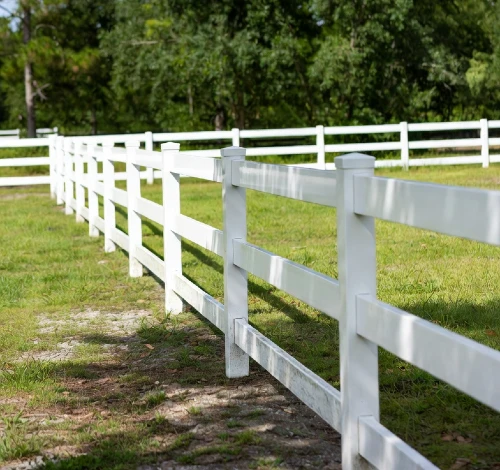
Vinyl has become the go-to material on horse farms and residential properties across the Ocala area, and it’s not hard to see why. It doesn’t rot. It doesn’t attract termites. It doesn’t need painting, staining, or sealing. You wash it with a hose and walk away.
Installed cost runs $20 to $40 per linear foot for a standard residential fence, and $30 to $55 per foot for heavier equestrian-grade rail fencing. That’s more than pine up front, but the lifetime cost is lower because the maintenance bill is essentially zero.
The knock on vinyl used to be that it looked plastic and cracked in cold weather. Neither of those complaints holds up anymore — not with the quality of product available today, and definitely not in a climate where cold weather isn’t the problem. Heat and UV are, and modern vinyl is formulated to handle both.
For horse properties specifically, white or light-colored vinyl rail creates a clear visual boundary that horses can see easily, which reduces fence-running and collision injuries. That’s not a cosmetic choice — it’s a safety one.
Chain Link
Chain link is the workhorse. It’s the least expensive option at $7 to $20 per linear foot installed in Central Florida, it’s nearly maintenance-free, and it lasts decades. It won’t win any beauty contests on a residential lot, but for property boundaries, dog runs, equipment yards, and agricultural enclosures, it does exactly what it needs to do.
If appearance matters, black vinyl-coated chain link is worth the upgrade. It blends into the landscape better than galvanized silver, and the coating adds a layer of corrosion resistance that matters in Florida’s humidity.
Aluminum
Aluminum fencing runs $25 to $45 per linear foot installed and gives you the look of wrought iron without the rust problem. It doesn’t corrode in humidity, it’s lightweight, and it comes in a range of styles from simple pool enclosures to ornamental designs.
It’s not a privacy fence — you can see right through it — so it works best for front yards, pool barriers, and decorative property lines. It also won’t stop a determined dog or contain livestock, so it’s not a fit for every property. But where it works, it works well and holds up for decades.
What Florida Does to a Fence That Other States Don’t
If you’ve lived in Central Florida for any amount of time, you already know the answer. But it’s worth spelling out, because it directly affects which material you should choose and how much you should spend on installation.
Humidity and Moisture
Central Florida averages over 50 inches of rain per year, and the humidity sits above 70 percent for most of the summer. Wood absorbs that moisture. It swells, it warps, it grows mold and mildew on the surface and rot underneath. Pressure treatment slows the process but doesn’t stop it entirely — that’s what the sealing and staining schedule is for.
Vinyl, aluminum, and coated chain link are essentially immune to this. If your main goal is a fence you don’t have to think about, that narrows the conversation quickly.
Termites
Florida’s subterranean termites are aggressive, and they love fence posts — especially the parts buried in the ground where you can’t see the damage until the post snaps. Pressure-treated wood resists them better than untreated, but “resists” is not the same as “prevents.” Annual inspections are part of owning a wood fence here.
Wind and Storm Season
This is where installation quality matters more than material. A vinyl fence on shallow posts will blow over just as fast as a wood fence on shallow posts. In Central Florida’s sandy soil, we set posts deeper than the standard depth you’d see in other states, and we use concrete footings on every post — not just the corners and gates. That’s the difference between a fence that survives a tropical storm and one that ends up in your neighbor’s yard.
Permits — When You Need One and When You Don’t
In unincorporated Marion County, you generally don’t need a building permit for a fence under six feet tall. That covers most standard residential privacy fences and farm fencing.
You do need a permit if the fence exceeds six feet, or if you’re building a barrier around a swimming pool — pool fences have to meet Florida Building Code safety standards, including minimum height and self-closing gate requirements.
If you’re inside the City of Ocala limits, the rules are slightly different and you should check with the city’s building services office before starting. And if you’re in an HOA, your covenants almost certainly have restrictions on fence height, materials, style, and sometimes even color. Check those before you sign a contract with anyone.
We handle permitting when it’s required, the same way we handle it on our marine construction and new home builds. One less thing on your list.
What About Farm and Horse Fencing?
Central Florida is horse country — Marion County alone has more horses per capita than nearly any county in the United States. We build a lot of farm fence, and the considerations are different from residential work.
For horse properties, the priority is visibility, safety, and durability in that order. Horses run into fences they can’t see and injure themselves on fences that break into sharp pieces. That rules out most barbed wire and thin-gauge wire fencing for equestrian use.
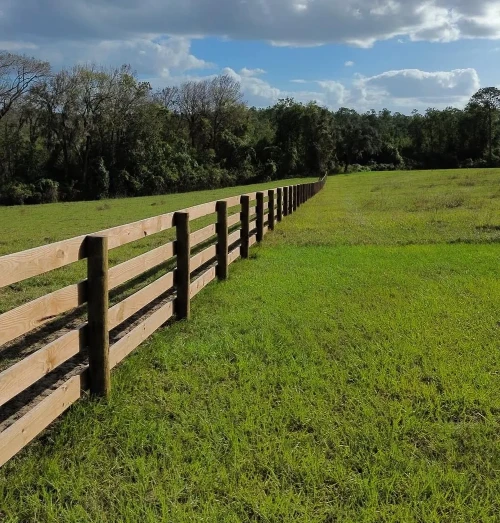
The most common setups we install on horse farms are three-rail or four-rail vinyl, high-tensile polymer rail, and in some cases, board fence with pressure-treated pine. Vinyl rail is the most popular because it flexes on impact instead of shattering, it’s visible from a distance, and the maintenance is minimal even across hundreds of linear feet.
For cattle, goats, and general livestock, the options open up — field fence, high-tensile wire, and pipe fencing all work well depending on the animals and the acreage. We’ll walk your property and recommend a setup based on what you’re actually containing and how the land lays.

How We Handle Fence Projects
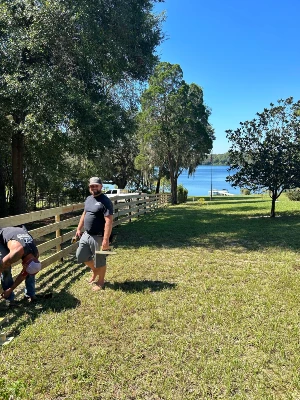
Fencing is part of the full range of construction services we offer across Central Florida. We build residential privacy fences, horse and farm fencing, commercial enclosures, and everything in between. A lot of our fence work happens alongside larger projects — a new barndominium that needs perimeter fencing, a waterfront property that needs a fence around the pool to go with a new dock or seawall, or a farm build that needs the whole property fenced before the horses move in.
We set our own posts, pour our own concrete, and don’t subcontract the work out. That matters in a climate where installation quality is the single biggest factor in how long a fence lasts.
Ready to Get a Quote?
Every fence project starts with your property, your goals, and your budget. We’ll walk the site, measure the runs, talk through materials, and give you a straight number — installed, permitted if needed, and built for Central Florida weather.
Contact us to get started, or call (352) 687-2030 to talk to someone today. You can also meet the team that will be doing the work.
You dream it, we build it.