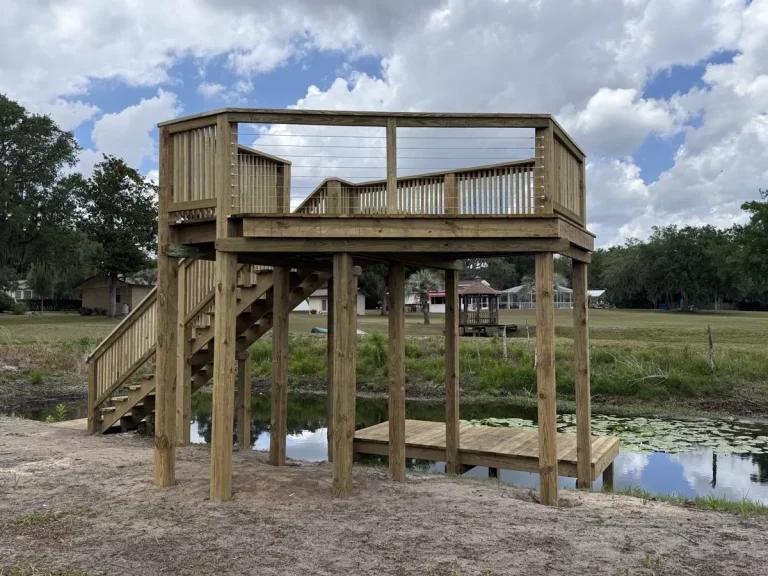
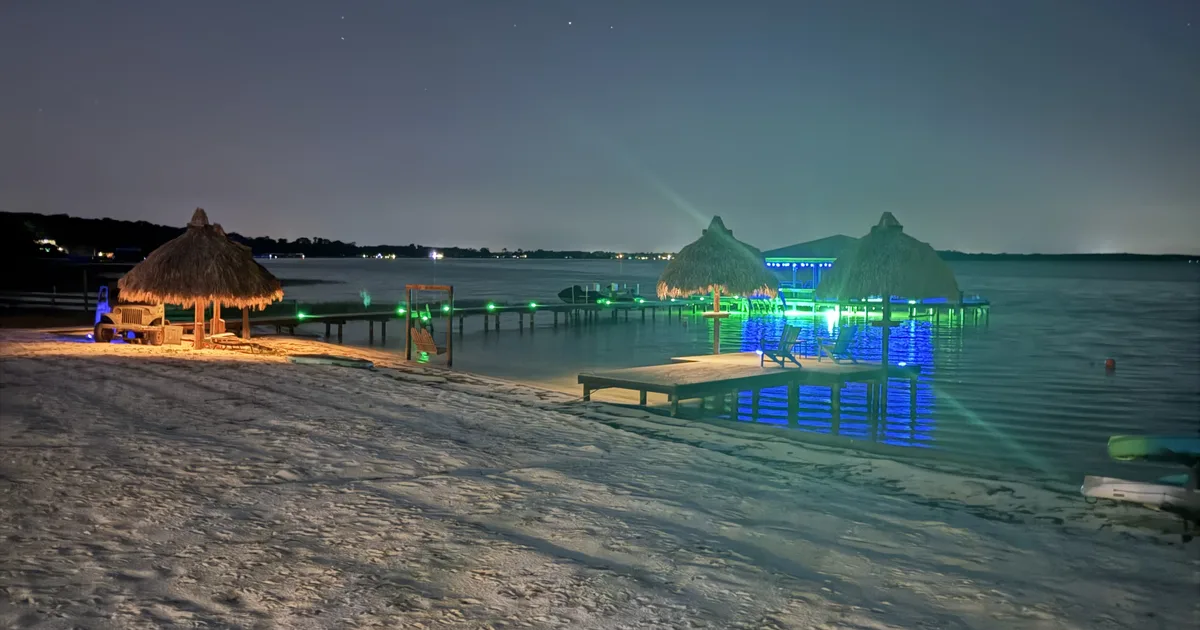
Building a Dock on Lake Weir, Florida: Sandy Bottoms & Real Costs
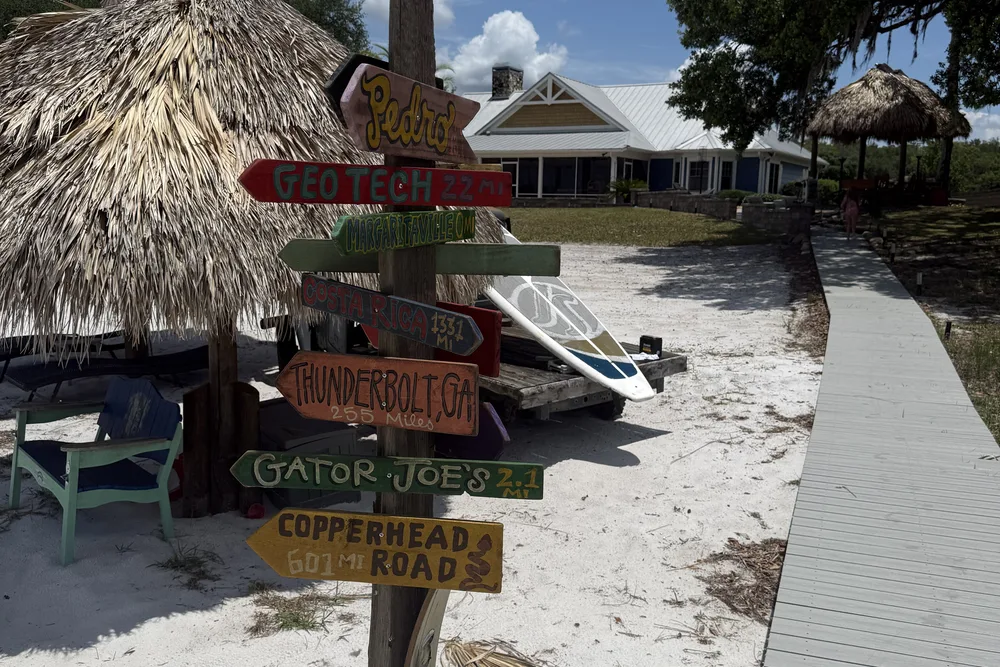
Lake Weir sits in southern Marion County — our backyard — and it’s one of the friendliest lakes in Central Florida to build a dock on. It’s sheltered, it’s clear, and it has a clean sandy bottom that draws families, skiers, and weekend boaters all summer. If you’ve ever pulled up to Gator Joe’s by water, you know the lake.
It’s also a very different build than a lake like Lake George, where the water’s rough and the bottom stays shallow so far out that docks have to run hundreds of feet to reach navigable depth. Lake Weir asks less of a dock in almost every way — which is exactly why it can be one of the more affordable docks we build. The sandy bottom is the reason, and there’s really only one thing about this lake you have to design around carefully: the water level moves.
Here’s what building a dock on Lake Weir actually involves.
Why a Lake Weir Dock Is an Easier — and Often Cheaper — Build
Two things make Lake Weir kinder to a dock budget than most of the water we work on: it’s sheltered, and it’s sandy.
It’s sheltered
The longest fetch on Lake Weir — the distance wind can travel over open water before it reaches your shoreline — is only about two miles. Compare that to Lake George, where wind runs eleven uninterrupted miles and builds waves that snap pilings and fatigue connections. On Lake Weir we can build with sensible, standard marine engineering instead of the heavily over-built, storm-rated framing an exposed lake demands. Less structure fighting the water means less cost.
It’s sandy
This is the big one. Lake Weir has a clean sandy bottom, and sand is the easiest material there is to drive a piling into. On a rock or hard-clay bottom — think Crystal River — setting pilings is slow, grinding, expensive work. On a coastal or saltwater dock you’re fighting harder bottoms, tougher permitting, and corrosion on every piece of hardware. On Lake Weir’s sand, pilings go in fast and seat clean. Driving pilings is the most labor-intensive part of any dock, so when that part goes quickly, the whole build gets cheaper. A dock on Lake Weir often costs noticeably less than a comparable coastal or saltwater dock for exactly this reason.
| Lake Weir | Lake George | |
|---|---|---|
| Setting | Sheltered (~2 mi fetch) | Open & rough (~11 mi fetch) |
| Bottom | Sand — fast, easy pilings | Sand, but fully exposed |
| Typical dock length | Moderate (~200 ft on many lots) | Long (~800 ft — shallow far out) |
| Build cost | Lower — often under a coastal dock | Higher — every foot is built walkway |
How Long Does a Lake Weir Dock Need to Be?
There’s no single answer, and don’t let anyone give you one. Dock length on Lake Weir depends entirely on your lot — how the bottom slopes off your particular stretch of shoreline and how deep the water gets, how fast. Some lots reach good depth quickly and need a relatively short dock. Others slope out gently and need to walk farther to reach water you can actually launch and run a boat in. It’s nothing like Lake George, where shallow water can force a dock out as far as 800 feet — Lake Weir lengths are far more moderate.
What you do have to plan for on Lake Weir — and what a lot of homeowners don’t think about — is that the lake level moves. Florida’s water table rises and falls with the rains and the seasons, and Lake Weir goes up and down with it. A dock built only for today’s water line can leave you stranded in a dry stretch, with a slip and a lift sitting over water that’s too shallow to use. We design for the range, not the snapshot: we look at where the water sits across high and low periods and build the length and height so your dock stays usable when the lake drops — and doesn’t get swamped when it comes back up.
Length is also the main thing that moves your price, since a longer dock is simply more pilings, more frame, and more decking. For a full Lake Weir setup — the dock out to good depth plus a boathouse to protect the boat — you’re typically looking at somewhere in the range of $75,000 to $85,000. A simpler dock without a boathouse costs less. We break down everything that drives dock pricing — length, pilings, decking, boathouses, and lifts — in our 2026 guide to what a dock costs in Central Florida.
Setting Pilings in Sand — Fast, but Not Careless
Sand is the easiest bottom to work, but easy isn’t the same as foolproof. Loose sand that takes a piling quickly is also sand that will let a shallow-set piling work loose over time — especially out at the dock head, where the boat, the lift, and a boathouse roof all add load. The skill on Lake Weir isn’t getting pilings in; it’s getting them in deep enough that they stay put.
We drive pilings here to a depth that accounts for the sandy substrate and the load each one carries, so the structure stays tight and level for decades instead of developing a wobble after a few seasons. Walkway pilings and dock-head pilings aren’t treated the same — the business end of the dock is doing the heavy lifting, and it gets built accordingly.
Boathouses and Boat Lifts on Lake Weir
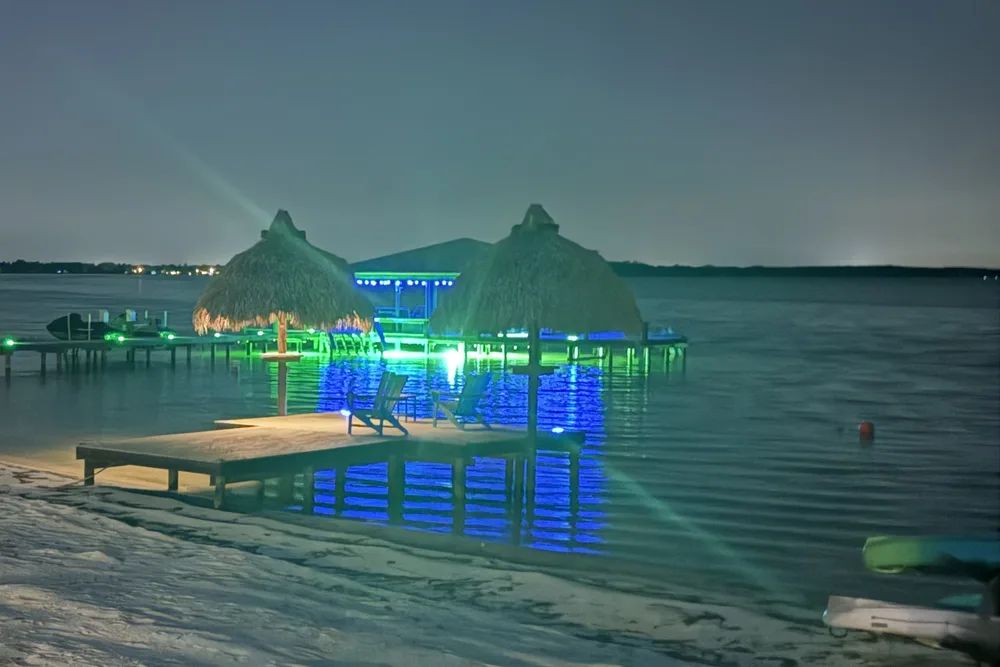
Lake Weir is a recreational lake first — people ski it, wakeboard it, and run boats on it all summer. So most serious docks out here include a boat lift, and many include a boathouse. A lift gets the boat out of the water when you’re not using it, protecting the hull and waterline from constant sun and the wet-dry cycle. A boathouse adds a roof over the top of that — shade, UV protection, and shelter from afternoon storms.
Because Lake Weir is sheltered, the boathouse engineering is more straightforward than on an open lake — we’re not fighting the wind uplift a Lake George boathouse has to resist. But it still has to be built right: a boathouse roof is a sail in any storm, and we tie ours down with the same hardware standards we bring to our barndominium and residential builds.
One Lake-Weir-specific note: it’s a swimming lake with clear, sandy-bottomed water, so the shallow approach matters. Ladders, swim platforms, and clean, snag-free hardware in the wading zone are worth getting right on a family lake like this one.
Permitting on Lake Weir
Lake Weir is in Marion County and falls under the St. Johns River Water Management District. Most standard residential docks qualify for a general permit (a $250 filing fee) as long as they meet the size and setback rules. Larger structures, boathouses, and anything involving shoreline work can require an individual permit with a longer review timeline.
We handle the full permitting process on every dock we build — the applications, the drawings, the agency correspondence, and the inspections — the same way we do on our seawall and marine construction projects across Central Florida.
Maintaining a Lake Weir Dock
A dock on a sheltered lake like Lake Weir is far easier to live with than one taking a beating on open water — but it’s still a wooden structure standing in water under the Florida sun, and a little attention each year goes a long way:
- Pilings at the waterline. The splash zone is where wear shows up first — watch for soft spots, checking, or marine growth holding moisture against the wood. Piling wraps applied early extend their life significantly.
- Fasteners and connections. Walk the dock once a year and check for any screws or bolts backing out, especially out at the dock head where the load is highest.
- Decking. Lake Weir decking takes a lot of sun — watch for cupping or cracking boards and replace them before they become a trip hazard or pull a fastener loose.
We service docks we’ve built and docks built by others. If your Lake Weir dock is aging, sagging, or storm-damaged, we can assess whether it needs targeted repairs or a rebuild.
Building on Lake Weir? Let’s Talk.
We’re Central Florida dock builders with deep roots in marine construction, and Lake Weir is right in our home territory in southern Marion County. We’ve built docks, boathouses, seawalls, and boat lifts across Marion, Lake, Sumter, Putnam, and Citrus counties — and we know a sheltered, sandy-bottom lake like Lake Weir calls for a different plan than a rough open lake or a coastal build.
If you’re planning a new dock, replacing one that’s seen better days, or adding a boathouse or lift, we’ll walk your shoreline, read your slope and depth, factor in the lake’s high and low water, and design a build that fits how you actually use the water. See how we build docks, then get a free quote — our goal is to quote your dock on site, from your exact shoreline. You dream it. We build it.
Lake Weir Dock Questions, Answered
Why is a dock on Lake Weir often cheaper to build than a coastal dock?
Lake Weir has a clean sandy bottom, and sand is the easiest material to drive a piling into. Driving pilings is the most labor-intensive part of any dock, so a sandy lake bottom keeps that cost down compared to a rock or hard-clay bottom or a coastal/saltwater build. Lake Weir is also sheltered — only about two miles of fetch — so docks don’t need the heavy storm-rated engineering an exposed lake requires.
How long does a dock on Lake Weir need to be?
It depends entirely on your lot — how the bottom slopes off your shoreline and how quickly it reaches navigable depth. Some Lake Weir lots need only a short dock; others slope out gently and need a longer one. Lengths are far more moderate than a lake like Lake George, where shallow water can force docks out as far as 800 feet. The dock also has to be designed for Lake Weir’s changing water level so the slip stays usable when the lake is low.
How much does a dock on Lake Weir cost?
A full Lake Weir setup — a dock out to good depth plus a boathouse to protect the boat — typically runs $75,000 to $85,000. A simpler dock without a boathouse costs less. Length is the main price driver, while the sandy bottom helps keep the piling work, and the overall cost, lower than a comparable coastal dock.
Do I need a permit to build a dock on Lake Weir?
Yes. Lake Weir is in Marion County and falls under the St. Johns River Water Management District. Most standard residential docks qualify for a general permit with a $250 filing fee, while larger structures and boathouses may require an individual permit with a longer review. JSC Contracting handles the full permitting process on every dock build.