
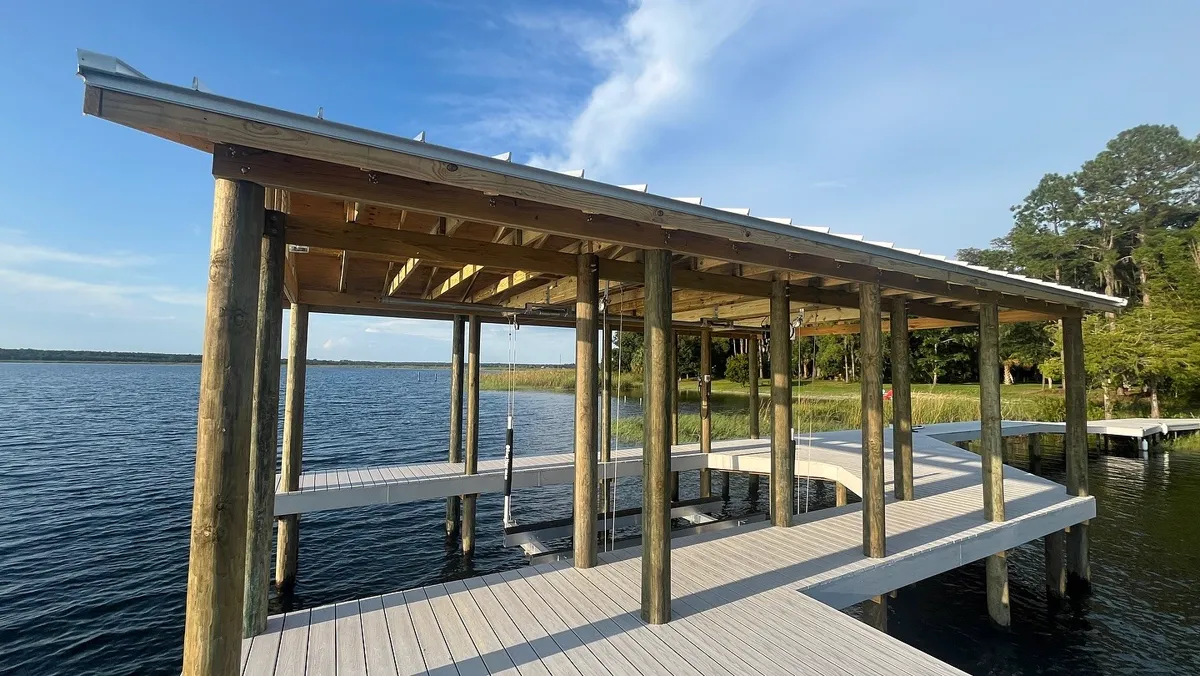
Dock & Boat Lift Repair: Fix or Replace? How to Tell Which Side of the Line You’re On
Every summer the same phone call comes in, usually right after the first big line of June storms rolls through Marion County: “My dock’s looking rough — do I need a whole new one, or can this be fixed?”
It’s the right question, and most people asking it have been given exactly two answers by the internet: a handyman who’ll screw new boards over anything, and a dock salesman whose answer to every problem is a full tear-out. The honest answer lives in between, and it’s knowable. We’ve been doing marine construction in Central Florida since before it was a business plan — docks, boathouses, seawalls, and boat lifts are the work this company was built on — and we repair docks we built and docks other people built. There’s no minimum job, so “just fix the bad section” is a real option here, not a brush-off.
Here’s the framework we use when we walk a dock, so you can walk yours and know which side of the repair-or-replace line you’re standing on before you call anyone.
The One Rule That Decides Almost Everything: Decking Is a Haircut, Pilings Are the Skeleton
A dock is two structures wearing one outfit. The decking and rails are the outfit — they take the sun, the foot traffic, and the splinters, and they’re designed to be replaced. The pilings, stringers, and framing are the skeleton — they carry the load, and they’re the part that decides whether your dock is worth saving.
Ugly decking on sound pilings is a repair. Every time. New boards, new fasteners, maybe new rails, and the dock is good for another decade at a fraction of rebuild cost. But fresh decking screwed over rotten pilings is lipstick on a structural problem — you’ve spent real money and the dock is exactly as close to failing as it was before.
The second rule is the one we borrow from every trade: the 50 percent rule. When the honest repair estimate crosses roughly half the cost of replacing the structure, replacement almost always wins — because a dock that needs that much work rarely stops there, and you end up paying twice. We put real numbers to full builds in our guide to what a dock costs in Central Florida — $40 to $60 per square foot for the dock structure itself — so that’s the yardstick your repair quote is measured against.
Symptom by Symptom: What’s a Fix, and What’s a Funeral
This is the walk-through we do on every assessment, in table form. Find your symptom, and you’ll know which conversation we’re going to have.
| Symptom | Typical Fix | When It Means Replacement |
|---|---|---|
| Soft, cupped, or splintering deck boards | Replace the bad boards — or re-deck the whole surface in wood or composite | The softness continues into the stringers underneath — probe them, not just the boards |
| Dock wobbles when you walk it | Tighten or replace corroded fasteners, add cross-bracing | The wobble is the pilings moving in the bottom, not the frame flexing on the pilings |
| Piling damage at the waterline (soft spots, hourglassing) | Wrap or sleeve the piling — caught early, this buys years | Multiple pilings rotted or wasp-waisted through — the skeleton is failing |
| Leaning dock head or lift corner | Re-drive or sister the affected pilings deeper | Widespread settling or scour — the whole dock was set too shallow for the bottom |
| Boat lift grinds, strains, or lifts slowly | Cables, pulleys, and motor service — all normal wear items | Bent cradle beams or a lift undersized for the boat it’s carrying |
| Lift sits out of level | Cable adjustment and re-leveling | The lift is level but the pilings holding it have moved |
| Storm damage | Rebuild the damaged section — docks are modular, and sections can be rebuilt to match | More than half the structure is compromised — document everything and involve your insurer |
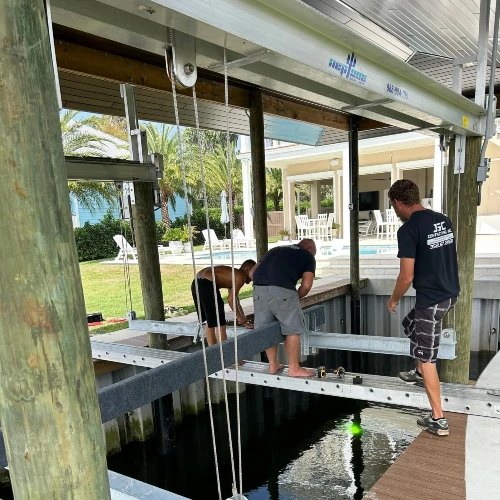
The 10-Minute Inspection: Walk Your Own Dock First
You don’t need a contractor to get a first read. Grab a flathead screwdriver and do what we do:
- Walk the deck slowly. Feel for boards that give, bounce that wasn’t there last season, and any lean at the dock head. Note where, not just whether.
- Probe the pilings at the waterline. Press the screwdriver into each piling right where wet meets dry — the splash zone is where wood fails first. Sound wood pushes back; rot takes the blade with almost no pressure.
- Look for the hourglass. A piling that’s narrower at the waterline than above and below it is being eaten through the middle. One is a repair; several are a countdown.
- Get under it if you can. From a kayak or wading, look at the stringers and joists under the decking. This is where rot hides — decking gets replaced, framing gets ignored.
- Check the fasteners at the dock head. The business end of the dock carries the boat, the lift, and the roof load. Backing-out screws and rust-streaked bolts show up here first.
- Run your hand down the lift cables. (Gloves on.) Frayed strands, flat spots, and rust bloom mean the cables are due — a cable that fails under load drops the boat.
- Cycle the lift and listen. A healthy lift hums. Grinding, straining, or lifting one corner slower than the other means the drivetrain wants attention now, while it’s still a small bill.
If everything above checks out and the dock just looks tired, you’re shopping for a re-deck, not a rebuild. If you found soft pilings in more than one or two places, keep reading.
Why Central Florida Docks Fail the Way They Do
Where your dock stands changes what kills it. We build and repair across two very different kinds of water, and the failure patterns are night and day.
On the sand-bottom lakes — Weir, Kerr, George — the enemy is loosening, not corrosion. Sand takes a piling fast, which is why lake docks are affordable to build — but sand also lets a shallow-set piling work loose over the years, especially out at the dock head where the lift and roof loads live. Add the fact that these lakes rise and fall with the water table, and you get docks that spend some seasons with their piling tops baking dry and others half-drowned — a wet-dry cycle that ages wood at the waterline faster than constant immersion would. We covered how we design around that moving water level when building a dock on Lake Weir — and an older dock that wasn’t designed for the range is a dock that strands its lift over dry sand in a low year.
On the salt and brackish side — Crystal River, Homosassa, the Nature Coast — the enemy is chemistry. Salt water corrodes every piece of hardware on the dock and chews lift cables on a schedule freshwater owners wouldn’t believe. The bottoms are rock and clay, so piling work is slower and pricier — which moves the repair-vs-replace math coastward: out here, saving sound pilings is worth more, because replacing them costs more.
And everywhere in between: storm season. June through November, every afternoon cell that trains across Marion County is load-testing your dock — wind on the boathouse roof, chop working the fasteners, debris hitting pilings. The docks that fail in a named storm are almost never healthy docks that got unlucky; they’re docks that went into the season with loose connections and soft pilings. A pre-season check is the cheapest insurance on this list.
What Repairs Typically Cost — and the Number to Compare Them Against
Every repair gets priced from your actual dock — but you deserve a neighborhood before anyone steps on your property. The ranges below are typical Central Florida ranges for this kind of work as of 2026; your water, your bottom, and the scope set the real number, and we’ll give you that number in writing after we walk the dock.
| Job | Typical Central Florida Range (2026) |
|---|---|
| Re-decking (new boards on sound framing) | Roughly a third to half the cost of new construction — the structure is the expensive part, and it’s staying |
| Piling wrap or sleeve (caught early) | $150–$500 per piling |
| Piling replacement | $300–$1,000+ per piling — sand bottoms at the low end, rock and clay at the high end |
| Boat lift cable replacement | $300–$800 |
| Lift motor replacement | $800–$2,000 |
| Full lift replacement (installed) | $8,000–$25,000+ depending on capacity |
| Full dock rebuild (the yardstick) | $40–$60 per square foot for the structure — our published new-build pricing |
Run the 50 percent rule against that last row. A few pilings, a re-deck, or a lift drivetrain refresh sits comfortably on the repair side. Soft framing plus multiple failed pilings plus a tired lift starts stacking toward rebuild money — and at that point you’re better off with a structure designed for how the water actually behaves on your shoreline, engineered once, warranted for life. On a repair, the same terms apply as on our builds: no minimum job, and a lifetime labor warranty on our work — lifts carry their 3-year manufacturer warranty on top.
When Replacement Is Honestly the Better Call
We repair for a living, so take this from the people with an incentive to say “fixable”: some docks shouldn’t be saved.
When the skeleton is gone. Widespread piling rot or framing failure means every repair is a down payment on the next one. Replace once, on your terms, instead of piecemeal on the dock’s terms.
When the dock can’t do the job you actually want. A dock built decades ago for a pontoon won’t carry the 10,000-pound lift your new boat needs, no matter how many boards we replace. Upgrading the boat is usually the moment to rethink the structure — our boat lift installation and repair crews reinforce docks and add pilings for bigger lifts constantly, but there’s a point where reinforcement is a rebuild wearing a repair’s name tag.
When the storm made the decision for you. If a named storm took more than half the dock, document everything with photos before touching it, call your insurer, and get a contractor’s written assessment of the full scope. We provide those assessments and repair estimates for claims regularly — and a proper one keeps you from settling for a patch on a structure that’s actually totaled.
One more honest flag: dock problems and shoreline problems travel together. If the land behind your seawall is slumping or washing out, fixing the dock first is doing the job backwards — that’s seawall construction and repair territory, and we’ll tell you if that’s what we’re looking at.
Get an Honest Read on Your Dock
We’re Central Florida dock builders first — a Florida certified residential contractor (CRC1332267) with our own marine crews and equipment, working lakes, rivers, and coast from Ocala out. That matters for repairs, because the person assessing your dock should be someone who knows what it costs to build one right — and has no reason to sell you a tear-out you don’t need or a patch that won’t hold.
We’ll walk your dock, probe the pilings, cycle the lift, and tell you plainly which side of the repair-or-replace line you’re on — and what each path costs, in writing. Get a free estimate, or call (352) 687-2030 and tell us what the dock is doing.
You dream it, we build it.